vpp-ipfix
IPFIX flow export enriched with application metadata — app name, category, TLS SNI, JA3 fingerprint.
vpp-ipfix exports IPFIX (RFC 7011) flow records directly from VPP’s data plane, enriched with nDPI classification metadata. Records carry the full 5-tuple plus application name, category, risk flags, TLS SNI, and JA3 fingerprint — sent to any standard IPFIX/NetFlow collector.
Status
Available. Compiled into ndpi_plugin.so. Apache 2.0.
Configuration
Enable in startup.conf alongside the ndpi plugin:
plugins {
    plugin default { disable }
    plugin ndpi_plugin.so { enable }
}

ndpi {
    flows-per-worker 65536
    tcp-idle-timeout 60
    udp-idle-timeout 30
}
CLI reference
| Command | Description |
|---|---|
set ndpi-ipfix exporter collector <IP> port <port> | Add an IPFIX collector |
set ndpi-ipfix enable | Start exporting flows |
set ndpi-ipfix disable | Pause export (collector stays configured) |
clear ndpi-ipfix exporter | Remove all collectors |
show ndpi-ipfix exporter | Show configured collectors |
show ndpi-ipfix stats | Export counters |
clear ndpi-ipfix stats | Reset counters |
Example output
vppctl set ndpi-ipfix exporter collector 192.168.1.100 port 2055
vppctl set ndpi-ipfix enable
vppctl show ndpi-ipfix stats
IPFIX export: enabled
  Collector 0: 192.168.1.100:2055 (fd=12)

flows exported:      924
PDUs sent:           155
ring overflow drops: 0
UDP send errors:     0
templates sent:      1
Custom Information Elements
Records use IANA standard IEs for the 5-tuple, counters, and timestamps, plus ntop enterprise IEs (PEN 35632) for application metadata:
| IE Name | IE ID (PEN 35632) | Type | Size | Description |
|---|---|---|---|---|
ndpiApplicationId | 1 | uint16 | 2 B | nDPI application protocol ID |
ndpiApplicationName | 2 | string | 32 B | Human-readable name (e.g. “YouTube”) |
ndpiCategory | 3 | uint8 | 1 B | Category (Streaming, VoIP, P2P…) |
ndpiRisk | 4 | uint32 | 4 B | Risk bitmask |
tlsSni | 5 | string | 64 B | TLS Server Name Indication |
ja3Hash | 6 | string | 33 B | JA3 client fingerprint |
Collector setup: nProbe + ntopng
The lab ships a ready-made Docker Compose configuration with nProbe as the IPFIX collector and ntopng as the flow browser. nProbe receives IPFIX on UDP/2055 and forwards flows to ntopng over ZMQ:
services:
  nprobe:
    image: ntop/nprobe:latest
    command: ["-i", "none", "-3", "2055", "--ntopng", "tcp://*:5556",
              "--dont-drop-privileges"]
    ports:
      - "2055:2055/udp"

  ntopng:
    image: ntop/ntopng:latest
    entrypoint: >
      bash -c "
        /etc/init.d/redis-server start
        ntopng -i 'tcp://nprobe:5556' --community -w 3001 --disable-login 1 &
        exec tail -f /dev/null
      "
    ports:
      - "3001:3001"
    depends_on:
      - nprobe
Start with docker compose up -d, then point VPP at nProbe:
vppctl set ndpi-ipfix exporter collector $(getent hosts nprobe | awk '{print $1}') port 2055
vppctl set ndpi-ipfix enable
Lab screenshots
The following screenshots are taken from the FlowLens software lab: VPP with nDPI → IPFIX → nProbe → ntopng.
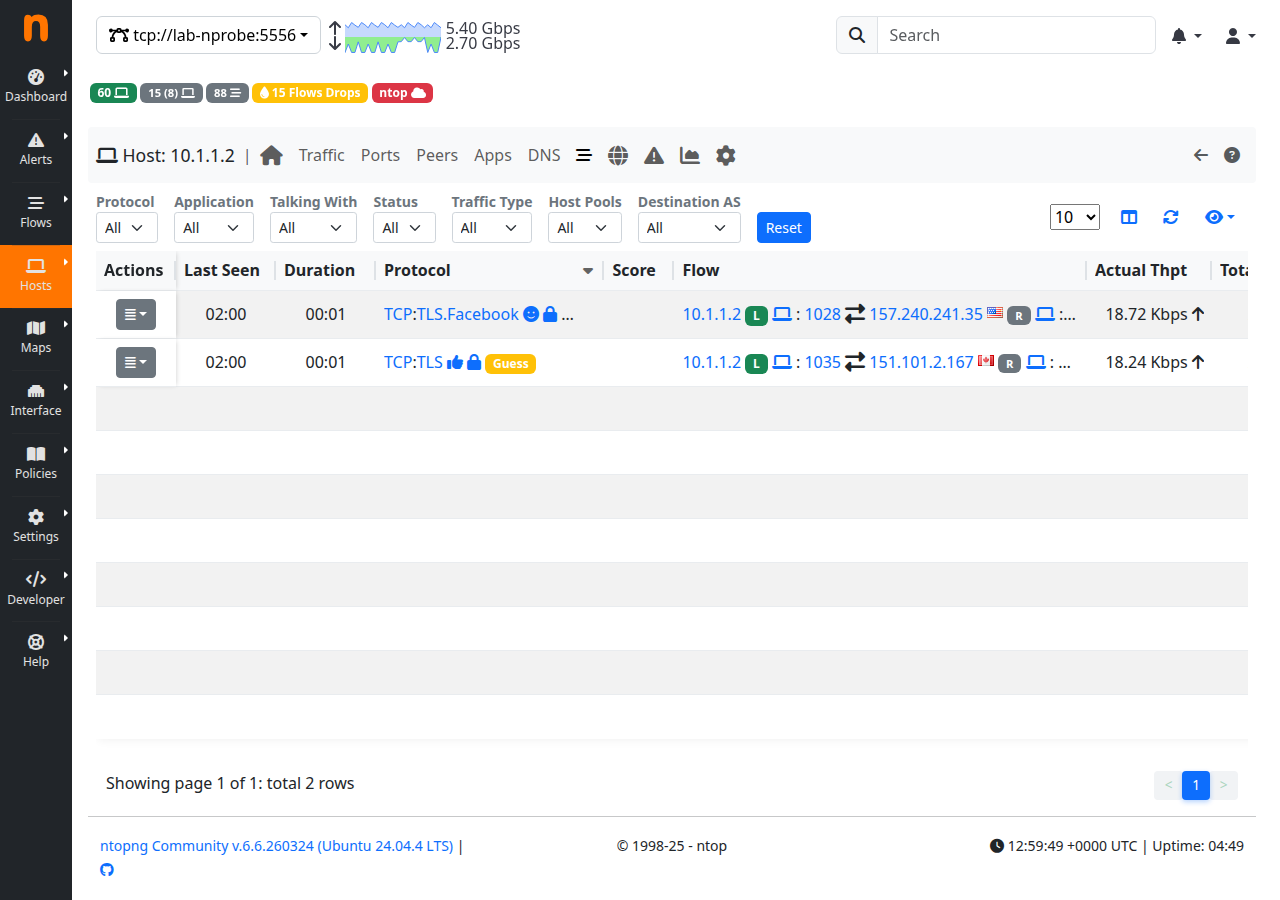
Live flow browser — TCP/TLS flows from VPP’s packet generator with correct 5-tuple data.
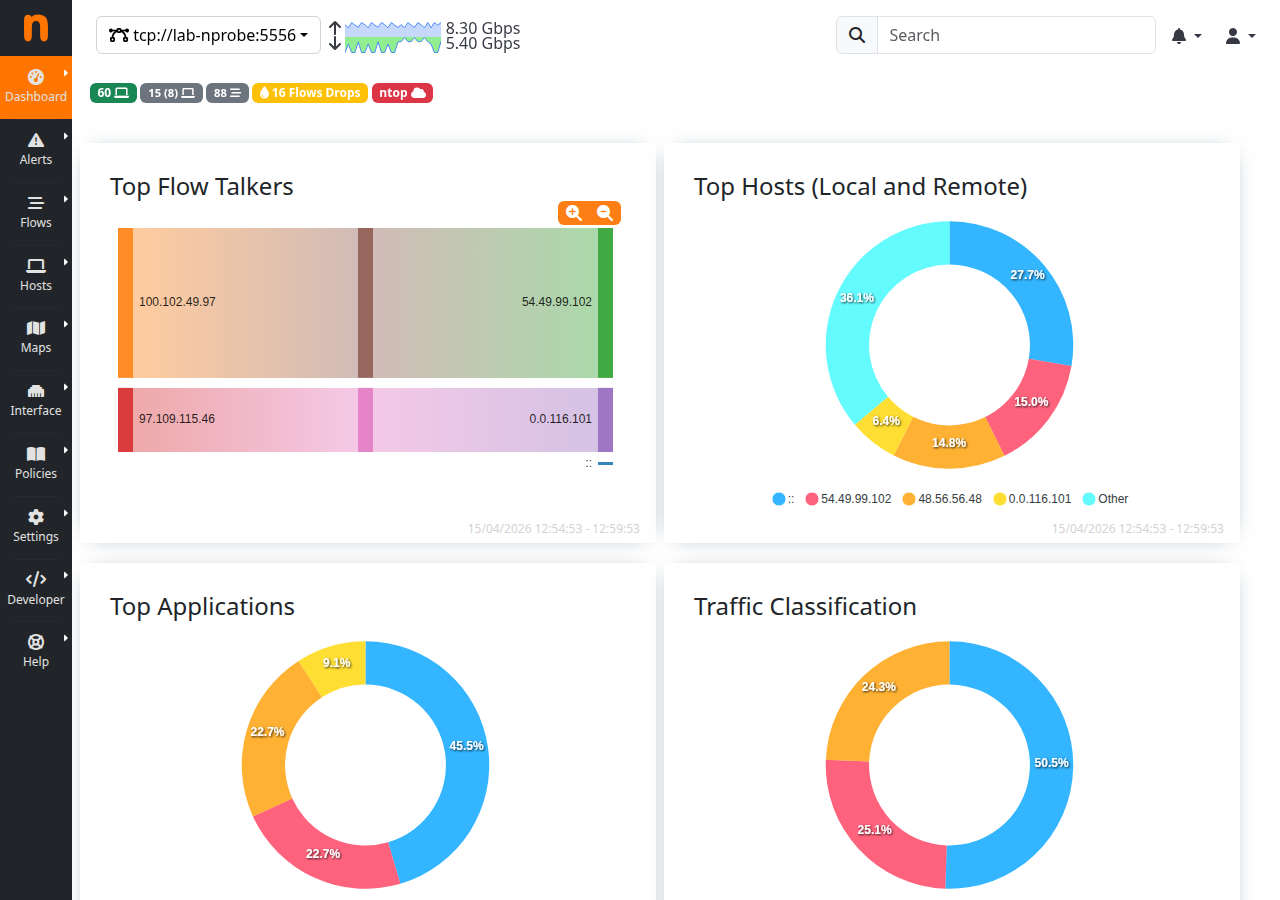
ntopng dashboard — Top Flow Talkers, Top Hosts, and Traffic Classification derived from the IPFIX stream.
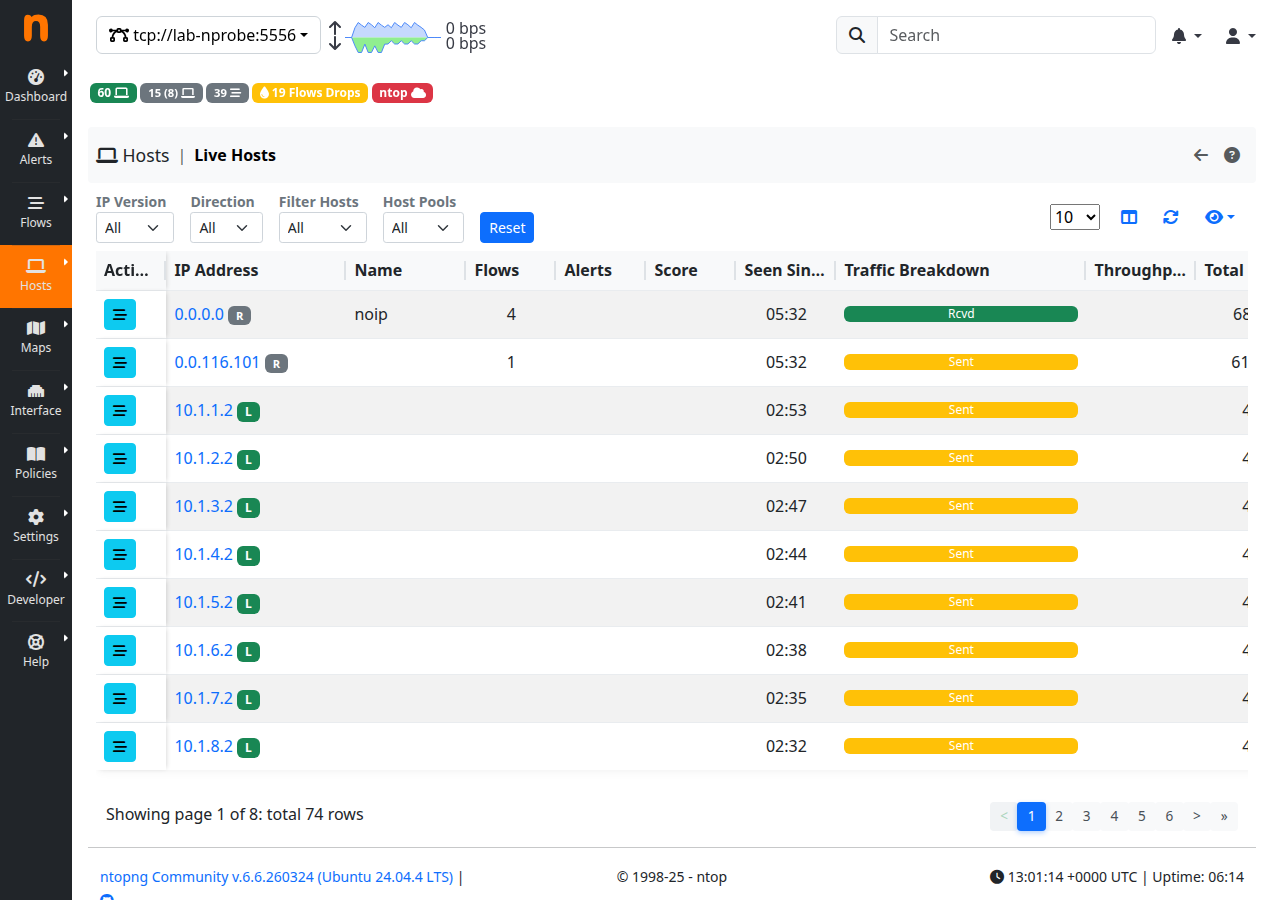
Per-host breakdown — individual host statistics aggregated from the IPFIX flow records.
Collector compatibility
Any RFC 7011 compliant IPFIX collector can consume the export. Standard fields (5-tuple, byte/packet counts, timestamps) are universally supported. Application metadata is carried in ntop enterprise IEs (PEN 35632) — collectors that support these IEs (nProbe/ntopng, ElasticFlow) will show application names and categories directly; others receive the standard fields and may apply their own classification.
Source
src/plugins/ipfix/ — available via PacketFlow commercial engagement.